
Expectation Bias
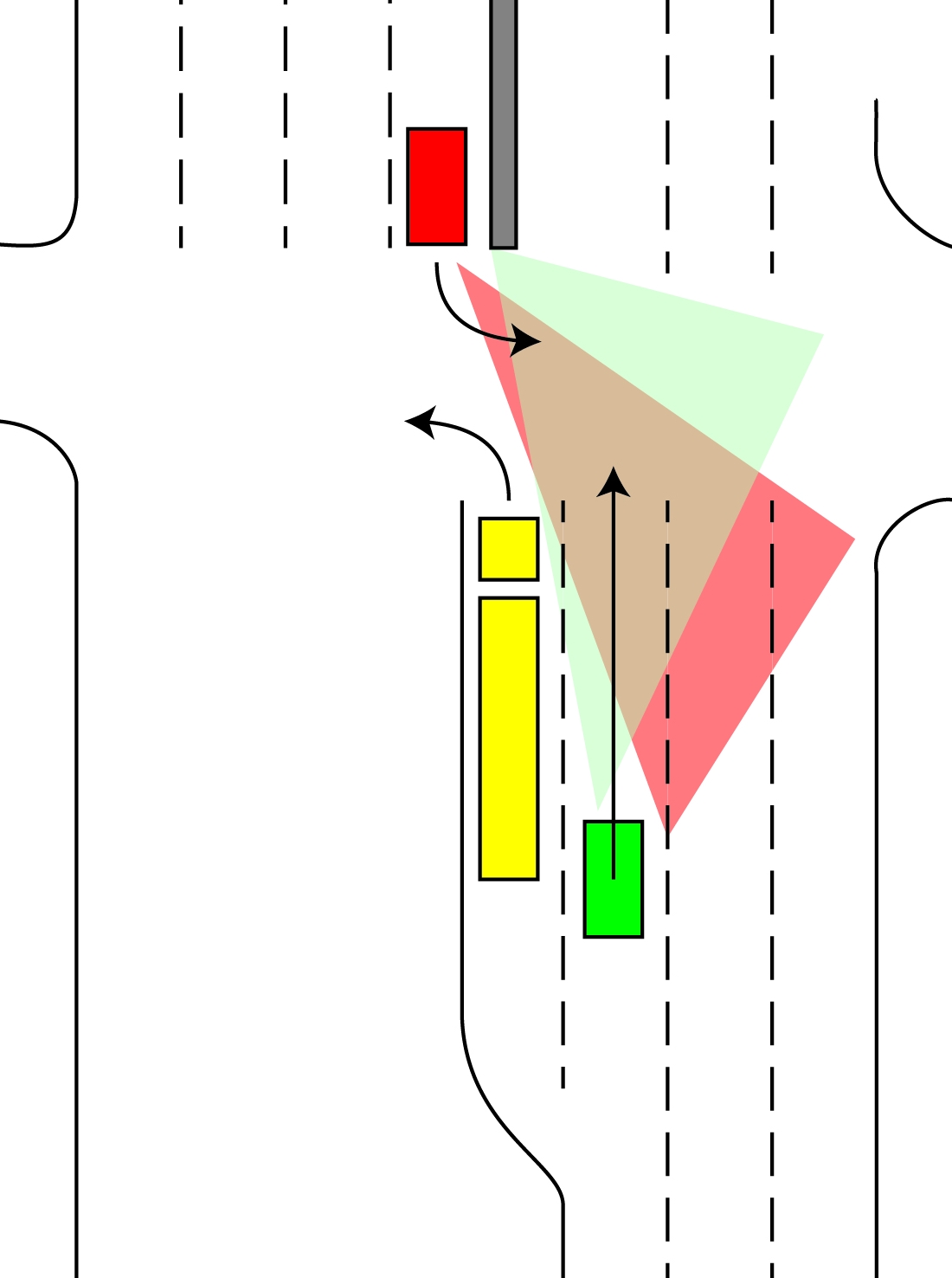 One of the deadliest errors drivers make is called “Expectation Bias.” We see what we expect; and we fail to see the unexpected.
I witnessed an accident last week, which perfectly illustrates the problem of Expectation Bias. In fact, I was very nearly involved in it myself.
The driver who caused the accident was Westbound, but turning Left, to the South. The other driver, directly in front of me, was going straight through the intersection. An Eastbound tractor-trailer was in the left-turn lane, waiting to turn North.
Because of the position of the left-turn lane, the tractor-trailer blocked the view of each of the drivers involved in the accident. The lady who was turning left looked at the intersection and it appeared to be clear, except for the truck which was waiting to turn left, opposite to her. The other lady, passing the tractor-trailer, could see that the intersection was clear in front of her, but because of the tractor-trailer, she couldn’t see the SUV that was preparing to turn left, in front of her. My illustration shows the 3 vehicles, and the field of vision of each driver.
Either driver could have avoided this accident, if they had recognized the hazard presented by the tractor-trailer. Each of them should have had mental alarms going off: “Danger, Will Robinson!” Rather than looking for the hazard, they were looking for a clear intersection, and that’s what they saw. They were victims of their own expectations.
Expectation Bias is a real threat to motorcyclists: Other drivers, expecting to see cars or trucks, fail to see motorcycles, even when they are in plain view. A friend of mine was struck by his neighbor (a biker himself), who said that he actually saw the motorcycle, but it failed to register.
How many of us get further into debt than we can afford, because we have such a rosy view of the future? We expect everything to work out fine, so we whip out the plastic. Expectation Bias strikes again!
As a rider, one of the most important safety lessons is learning to see hazards everywhere. Expectation Bias is a threat to our ability to recognize hazards; we also need to recognize our expectations (and the expectations of other drivers) as a potential hazard.
One of the fellows who taught me to ride told me that I should always pretend I was driving a Semi. “Learn to occupy as much space on the road as a tractor-trailer rig; Don’t let anyone get inside your space.” We overcome other drivers’ expectation bias by making ourselves more visible and audible, and by forcing them to treat us like a larger vehicle.
Filed under Uncategorized
In praise of new tires… and great customer service
Several people “liked” my post a while ago, when I got a new back tire on my bike.
The tire was faulty. It kept thrusting the rear end of the bike back and forth, sideways. Not a good feeling at highway speeds. So I got the guys at Cycle Gear to replace it. They gave me an identical tire, a Michelin Pilot 3.
I rode on that tire for nearly a month, and kept having issues with it. It felt great at speeds below 55, but at highway speeds, it was unstable.
I did some research… Michelin doesn’t recommend any of their tires for my bike. On the BMW sites, everyone said they were riding on the Metzler tires that BMW puts on the bike, or on Avon tires.
Last week, I ordered a new set of Metzler tires. What a difference! The bike feels safe to ride again.
Best part: The guys at Cycle Gear swapped out the tire without a comment. They were surprised that I had trouble with it, but they honored their 100% Satisfaction Guarantee, even though I was not returning an “undamaged” item. I did ride on the tire for a month or so.
Kudos to Cycle Gear!
Filed under Uncategorized
Book Review: ROUTE 66: A Crash Course in Navigating Life with the Bible by Krish Kandiah
Most people settle for reading the Bible in a year. Seems like every Bible-related website has a plan. So how do you go one better on that?
Krish Kandiah’s “crash course in navigating life with the Bible” has an 8-week plan, complete with study guide, discussion questions and prompts for a “travel journal.”
Route 66 uses travel/car metaphors to guide the reader through the Bible. The original Route 66 is the famous “main street of America,” the historic highway from Detroit to Los Angeles, John Steinbeck’s “Mother Road.” The metaphor is useful for a journey that the author hopes will be life-changing.
Route 66 is a book on hermeneutics, for people who have never heard of hermaneutics, and probably don’t care. For students of the Bible, the easiest explanation is that it is a light version of Fee and Stewart’s How to Read the Bible for All Its Worth.
That’s not to say it’s unworthy. It’s written for a different audience. An audience who may have little or no previous exposure to the Bible, who are curious enough about it to take on an 8-week challenge to discover what it’s all about.
In 8 weeks, there are discussions of 8 Biblical genres, and how to read them and make sense of them. There’s a brief reading for each day of each week, focusing on specific aspects of the genre in question. Each reading has questions to be responded to in a “travel journal,” and each week ends with a suggested small group study.
As one might expect in such a book, difficult questions get a mention and a nod, but hardly enough discussion. For example, in the reading on Leviticus, Kandiah suggests that there are three different kinds of laws: [obsolete] Civil Laws, [obsolete] Ceremonial Laws, and [eternal] Moral Laws. “In practice,” he says, “the laws don’t always fit neatly into each category… The Old Testament itself gives no hint of any such distinctions.” He then invites readers to use these categories to categorize the laws in Leviticus chapter 19. Too neat, too quick, and hardly fair to the reader, especially a novice in Bible studies.
Of course, it’s not intended to be a theological treatise, rather a “crash course.” Any author attempting to introduce the subject matter of the Bible in less than 200 pages is bound to gloss over a few things. The idea is to get people reading the Bible and contemplating it. If they get past the first hurdle (actually reading it), they presumably have more time to contemplate more difficult questions at their own leisure.
I described this book as “Fee and Stuart light” to one of my friends, and he asked whether Kandiah takes a higher view (than Fee and Stuart did) of the Old Testament. Given the limitations of a brief introduction, Kandiah seems always to explain the Old Testament in terms of Jesus Christ. Some things point to Christ; others pre-figure Christ; others are fulfilled by Christ. It is perhaps simplistic, but it is a starting place.
As a Sunday-school teacher, I find the book intriguing. As I read it, I tried to imagine how I would deal with a class who met once a week to discuss the material, as suggested. I’m not sure whether Kandiah has given me too much material, or too little. Certainly I will be using this little book as a resource; and perhaps I will try an 8 week crash course.

 )
)Filed under Book Review, Books, The Bible
Looking a long way down the road
Hindsight might be 20/20; but it’s far safer to have good foresight.
Earlier this winter, I was riding to work, on my regular commute down I240. I was well into the corner at Malfunction Junction when I noticed that the traffic was stopping ahead of me. I had to get on the brakes hard. My back tire went into a skid. Not a fun feeling in a corner at 60 MPH!
It reinforced an old saying among bikers: “Look through the corner.” Pilots have a similar saying: “Never let the airplane get out in front of you.”
Whatever you are doing, it’s a lot smarter to be looking (and thinking) way out in front. It’s called Situational Awareness. When I’m in traffic, I try to watch 6-8 cars ahead of me, at least. I know that when number 8, way out in front of me, slams on his brakes, everyone behind him is going to do the same, one after the other. There’s no good reason to be caught by surprise, and no good reason to be rear-ended because I surprised the guy behind me. Been there, done that. It’s no fun.
It’s a smart concept in day-to-day living as well.
I changed careers quite a few years ago. I started noticing all the “old” guys I was working with. Grouchy old curmugeons. Bleeding ulcers. Alcoholics. Divorced. It was a real eye opener. It was a way of looking a long way down the road that I was on. I decided I had to get onto a different road. If I did the same things they had done, I was likely to end up where they were. I’ve never looked back.
Who wants to be the guy who loses his house or his car, because he can’t make the payments? Who wants to retire and discover that he has to go back to work, because he doesn’t have enough to live on?
Nobody plans to have an accident. Nobody plans to crash and burn, either literally or figuratively.
Safety isn’t an accident. Accidents happen, but by and large, situational awareness can keep you from crashing and burning–whether you’re driving a motorcycle or choosing a career.
And looking a long way down the road can make dreams come true. Ever dream about the kind of person you’d like to marry your granddaughter? My parents did.
My parents had a dream about the kind of home their grandchildren and great-grandchildren would grow up in.
How do you control something like that? You look a long way down the road. You start out by deciding what kind of home your children grow up in, and by making choices about who your children hang out with. We spent all summer in Bible camps. We drove hundreds of miles to attend Christian Youth retreats. We attended a Christian high school and most of us went to a Christian college.
My parents invested thousands of dollars to influence who we married. The Christian college and Christian high school weren’t primarily for the kind of education we got, but because of the kind of people we were going to hang out with. They were playing the odds, looking a long way down the road.
How did they do? I married a girl I met–at the age of 12–at a Bible camp. Almost all of my brothers and sisters married someone they met at school. And–go figure–most of the grandkids are marrying someone they met at a Christian college. Nobody in the family has been divorced. We’ve been through rocky times, but it appears, by and large, that my parents achieved their dream.
Always look through the corner. Never let your motorcycle get out in front of you. Look a long way down the road.
Filed under Human Factors, Motorcycle Safety, Wise living
Accident Statistics
I was going to include this link in my last post, but it just didn’t seem to fit anywhere. It’s still worth posting.
Some sobering facts, and a few things that are good to know. Here’s the link:
Filed under Motorcycle Safety
What’s the most dangerous element about riding motorcycles?
My mother is convinced that riding motorcycles is inherently dangerous. She’s not alone.
But if riding a motorcycle is inherently dangerous, what is the most dangerous thing? People.
Almost all accidents are caused by people. So if we want to be safer, we have to do something about people.
In aviation safety, there are two disciplines–both related to Safety Management Systems–that address people issues: Human Factors and Threat and Error Management.
Human Factors is a study of the psychological and sociological factors which can cause accidents and incidents. Threat and Error Management involves systematically looking for threats and errors, and eliminating or mitigating them.
For example, if I’m in a hurry, there are a whole host of Human Factors that come into play. The sense of being in a hurry is itself a threat, and if I’m going to be safe, I have to do something to eliminate or mitigate that threat. I remind myself that no matter how much I speed, I can’t make much difference to my arrival time, and I set my cruise control to eliminate the temptation to jump on the throttle.
By the way, all this has practical application in day-to-day living as well. I have to take Human Factors into account when I deal with my renters. I have to be prepared for cultural differences to affect my communication with my renters, for potential misunderstandings.
I also use Threat and Error Management regularly in my day-to-day life. Even though I’m certain I’m not going to do anything I shouldn’t, I make certain I’m never alone when I go to any of my rental properties, particularly when I’m dealing with women or children. I have to be aware of the various threats involved in that kind of situation. There’s a threat of gossip, about what I’m doing there. There’s a threat that my motives may be misunderstood, or that the other person’s motives may not be as pure as they should be. I can mitigate or eliminate most of those threats by taking someone (usually my wife) along.
I’ve been working with Flight Safety and Flight Standards departments now for more than 10 years, and I’ve learned a lot from them. It’s made me a safer motorcycle rider, and sometimes a wiser person. I’d like to try to apply some of the elements of a good Safety Management System to riding a motorcycle, and to living a wise life. So, watch for more about Human Factors and Threat and Error Management.
Ride Safe!
Book Review: Bittersweet–one of the best books I’ve read this year
My femal e friends tell me that I’m “man enough” to read a “Chick” book and live to talk about it. That’s a good thing, because reading Bittersweet is like peeking into a girlfriend’s diary. This collection of essays is sort of a literary version of a chick flick.
It deals with heartbreak, rejection and renewal. Shauna Niequist writes about her own experiences, drawing you into her emotions, and hopefully, lifting you to a better place as she struggles and learns.
Of course, the experiences she describes–losing a job; losing a child; moving; enjoying friends for friendship’s sake–are universal, but Niequist deals with them from an unapologetically feminine perspective. She shares “thoughts on change, grace and learning the hard way” in a way that keeps me wanting to peek into her diary for one more chapter.
Niequist points out, in many ways, that life is worth living, even when life in the here and now is horrible, or frightening. When we learn to embrace the bitter, we also find the sweet; and the sweet is sublime.
You can see more about Bittersweet at http://zndr.vn/dl4aEt
This review was written for LibraryThing Early Reviewers. (  )
)
Filed under Book Review, Books
Making sure my ride is safe
I really enjoy riding my bike, even if it’s just commuting to work. You can tell how much I enjoy it: I put about 10,000-12,000 miles on my bike every year.
I also spend a fair bit of time laying in my driveway, working on this or that. I do my own oil changes and as much maintenance as I can. Changed out the brake lines and changed the brake fluid. Getting ready to take all the tupperware off and change the plugs and air filter.
Last week, I discovered I had a flat tire, and in short order discovered the cause: a screw right through the face of the tire. I thought about patching it, or even plugging it, but wasn’t terribly enthusiastic about trusting my life and limbs to a tire I wasn’t sure of. Then it occurred to me that I had purchased a road hazard warranty.
It turned out that the road hazard would pay for about $70 on a new tire, and I upgraded a bit, so after mounting and balancing, I handed over a cool $200, and a few days later they got my tire in and mounted it and balanced it. Or so I thought. Seems you need a special balancer for wheels that mount on a single-sided swing arm (i.e., BMW & Ducati). Easy to change the tire, not so easy to balance it.
So right now, I’ve got an unbalanced rear tire. At 65-75 mph, it feels sort of like riding a fish. There’s a side-to-side oscillation that has nothing to do with my input, nor with the road surface. If you’ve ever towed a trailer that’s been loaded too light on the tongue, you have an idea what I’m feeling. It’s like someone is pulling back and forth on my trailer hitch while I’m riding down the highway.
The easy solution is Dyna Beads, those ceramic wonders that you dump in your tire and they automatically balance the tire. I’ve driven with Dyna Beads in my Goldwing tires for 2 years now, and I have no complaints, but the physics elude me. It’s sort of like believing in magic. I get a sense of how my father felt when he was dowsing for water. He constantly muttered to himself, “There’s no scientific reason why this should work,” yet it always did.
So I’ve got a question, and a challenge. Is there anybody out there who understands the science of how Dyna Beads work? Everyone I know has had good experiences with them… is there anyone with a horror story? I’d love to know.
Filed under Equipment safety, Motorcycle Safety, Tires
Book Review: First-Time Landlord by Janet Portman et al
 This is a good basic book on renting a single-family home. It is well-organized, with references to more specialized books and online resources. It would be handy for anyone who is thinking of purchasing a home to rent, or who has a home that they want/need to rent.
The sub-title is a bit misleading. Many of the examples and equations provided have more to do with multi-unit properties. That’s not necessarily a bad thing, but as an investore dealing in single-family homes, I know that I deal with quite different issues than an apartment owner. If the book really specialized in the single-family home market, it might be better to stick with examples in that market, or highlight multi-family investment properties as a contrast.
Throughout the book, there are “USA Today Snapshots.” I would have expected them to have some relationship to the text. Sometimes they do. In a section on pets, there is a graphic about pet owners.
More often, they don’t; they seem to be thrown in at random. In a section on relationships with investment partners, there’s a graphic about spouses who lie about finances. In a section on financing, there’s a graphic about joining a business association. Such slap-dash choices suggest that the editors made a decision that a certain percentage of the page had to be graphics, and then the layout artist filled in the spots with whatever was available.
I’m going to keep the book around as a reference work. It looks like a useful tool for a small-time investor.
This review was written for LibraryThing Early Reviewers. (  )
)
First-Time Landlord: Your Guide to Renting out a Single-Family Home (USA Today/Nolo Series) by Janet Portman, Marcia Stewart, Michael Molinski NOLO (2009), Edition: 1st, Paperback, 336 pages
Filed under Book Review, Books, Business
 ralphwwilliams